For many growing Canadian workshops, the forklift is the unsung hero of the floor. It’s versatile, familiar, and mobile. However, as production scales and floor space becomes a premium, there comes a tipping point where floor-based material handling actually begins to hinder your efficiency rather than help it.
If you feel like your team is playing a constant game of “Tetris” with pallets and machinery just to move a single load, it might be time to look up.
Here are five definitive signs that your facility has outgrown the forklift and is ready for an overhead crane system.
1. You’re Running Out of Maneuverable Floor Space
A forklift requires wide “traffic lanes” to operate safely. In a crowded shop, these aisles represent “dead space”—valuable real estate where you could be placing another CNC machine, a welding station, or more inventory.
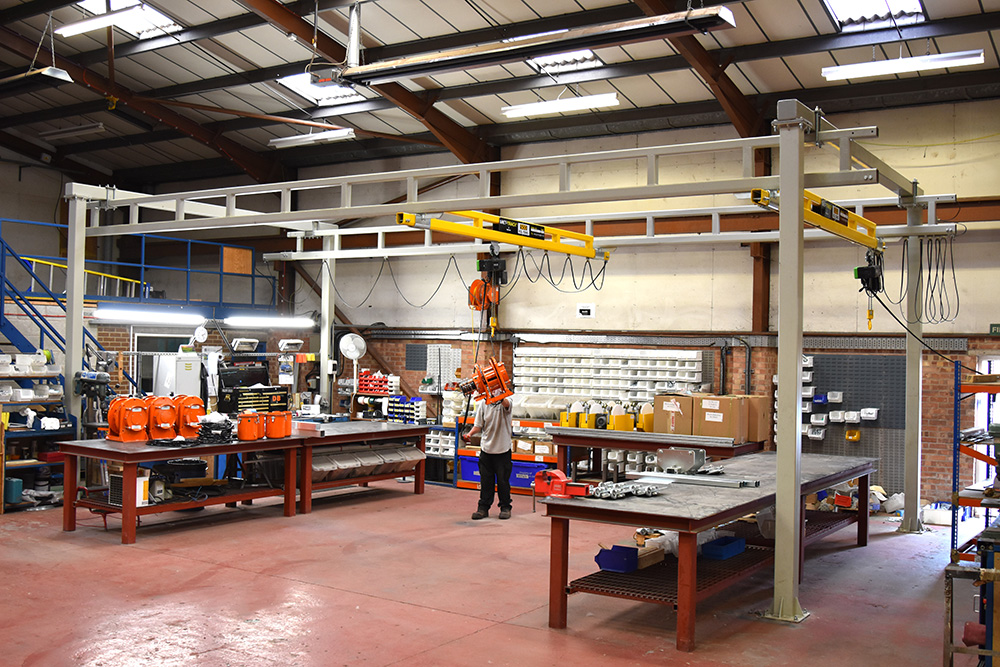
The Overhead Advantage: By moving your lifting to the ceiling, you reclaim your floor. Bridge cranes or workstation monorails allow you to utilize every square inch of your facility for production, effectively expanding your shop’s capacity without a physical expansion of the building.
2. Frequent “Near Misses” or Safety Concerns
Forklifts are responsible for a significant percentage of industrial workplace accidents. Pedestrian traffic mixed with heavy machinery in tight quarters is a recipe for disaster. If your safety logs show an increase in “near misses,” or if your operators are constantly maneuvering in blind spots, your current system is a liability.
The Overhead Advantage: Overhead cranes remove the “collision” factor from the floor. By lifting loads above the heads of workers and machinery, you create a clear separation between personnel and heavy materials, significantly lowering the risk of workplace injuries.
3. Inefficient Load Positioning and “Dead Time”
Forklifts are great for moving things from Point A to Point B, but they lack precision. If your process requires frequent, minute adjustments—such as positioning a heavy part onto a lathe or aligning a component for assembly—a forklift is often too clunky. The time spent “nudging” a load into place is “dead time” that eats into your profit margins.
The Overhead Advantage: Systems like Metreel light rail cranes or bridge cranes offer X-Y axis precision. This allows operators to spot a load with millimetre accuracy, reducing fatigue and drastically speeding up assembly times.
4. Lifting Requirements Exceeding Mast Stability
Are you pushing your forklift to its capacity limit? When a forklift reaches its maximum lift height or weight capacity, the center of gravity shifts, increasing the risk of a tip-over. If your loads are getting heavier or you need to stack higher than a standard mast allows, you are compromising the integrity of your equipment.
The Overhead Advantage: Overhead cranes are engineered for specific weight classes (Classes A through F) and offer a stable, fixed lifting point. Whether you are lifting 1 ton or 50 tons, the stability is built into the structure of your building or a dedicated runway, not a mobile wheelbase.
5. High Maintenance Costs of Mobile Equipment
Forklifts have tires, engines, hydraulic systems, and brakes that require constant maintenance. Between fuel (or battery charging) and the wear and tear of driving over shop floors, the “Total Cost of Ownership” (TCO) of a forklift fleet is often much higher than shop owners realize.
The Overhead Advantage: While an overhead crane is a capital investment, its maintenance cycle is significantly longer. Without the friction of floor travel or the complexity of an internal combustion engine, a well-maintained crane system can last 20+ years with minimal intervention.
The Compliance Factor: Ontario Safety Standards (OHSA)
In Ontario, moving heavy loads isn’t just about efficiency; it’s about strict legal compliance under the Occupational Health and Safety Act (OHSA).
While forklift operators require specific certification and frequent recertification, they are still limited by the “human element” of navigating a shared floor space. According to the Ministry of Labour, “struck-by” accidents involving mobile equipment remain a leading cause of industrial injuries.
Switching to an overhead system simplifies your safety profile in three ways:
- Controlled Travel Paths: Unlike a forklift that can travel anywhere, a crane moves along fixed rails (Bridge) or a set radius (Jib). This makes safety zones easier to predict and enforce.
- CSA B167-16 Standards: Overhead cranes in Ontario must adhere to the CSA B167-16 standard. This requires annual professional inspections, which, while mandatory, provide a documented “paper trail” of safety that can lower insurance premiums and protect you during a Ministry audit.
- Ergonomic Protection: A significant portion of Ontario WSIB claims are for “Musculoskeletal Disorders” (MSDs). Overhead cranes do the heavy vertical and horizontal work, preventing the back and shoulder strain often associated with manually guiding loads or climbing in and out of forklift cabs.
Making the Switch
The transition from a forklift-reliant shop to an overhead-optimized facility is a milestone in any manufacturing business. It signals that you are moving from “handling” materials to “mastering” your production flow.
At Pro-Lift Crane & Hoist, we specialize in helping Ontario shops identify the exact system—be it a Bridge Crane, Jib Crane, or a Metreel Workstation—that will unlock their next level of productivity.