
When a workshop begins upgrading its material handling systems, one question usually comes first: What type of crane do I actually need to maximize efficiency?
The answer depends on far more than lifting capacity alone. Your industrial crane selection comes down to understanding your facility’s lifting “envelope”, aka the total three-dimensional area where loads must move safely and efficiently.
Some operations need precise workstation lifting. Others require full-facility coverage capable of moving heavy loads across multiple bays. In some cases, portability matters more than permanent infrastructure. Understanding the strengths and limitations of each crane type is critical before making a capital investment.
This guide breaks down the three most common types of industrial systems used in Canadian workshops and manufacturing facilities, including their ideal applications, lifting coverage, span capabilities, and operational advantages.
Understanding Your Lifting “Envelope”
Before executing an industrial crane selection, it’s important to precisely define your lifting envelope. A lifting envelope is the total three-dimensional area within which a crane can safely move a load. Navigating your specific load capacity and workspace limitations involves assessing:
- Horizontal travel and vertical lift height
- Hoist and trolley movement
- Reach, span, and rotation capabilities
- Physical obstructions within the workspace
The larger and more complex your lifting envelope becomes, the more sophisticated your overhead framework typically needs to be.
For example:
- A welding station lifting parts within a single work cell may only need a small freestanding jib crane.
- A fabrication facility that moves steel elements throughout the shop may require an overhead bridge crane layout.
- A temporary maintenance or assembly operation may benefit from a portable gantry or tracked gantry system.
The goal is not simply to buy the “biggest” crane. The goal is to install the most efficient lifting solution for your workflow, building structure, and production demands.
Bridge Cranes: The Gold Standard for Full-Facility Coverage
For large manufacturing facilities, bridge cranes are considered the ultimate configuration in overhead material handling.
A bridge crane consists of parallel runway rails, one or two horizontal bridge girders, and a hoist and trolley system that moves dynamically along the bridge. This design allows movement along three independent axes:
- The bridge travels linearly down the length of the building.
- The trolley moves transversely across the bridge span.
- The hoist raises and lowers the load vertically.
The result is complete rectangular lifting coverage across a large production area. Learn more about structural variations on our dedicated Overhead Bridge Cranes product page.
Best Applications for Bridge Cranes
- Steel fabrication facilities and heavy equipment assembly
- Automotive and aerospace manufacturing plants
- Warehouses with continuous or repetitive heavy staging
- CNC loading and precision machine shop routing
They excel in heavy industrial environments where loads must move frequently, seamlessly, and efficiently across long distances.
Advantages of Bridge Cranes
- Full Building Coverage: Services nearly the entire production floor, maximizing plant layout flexibility.
- Extreme Capacity Boundaries: Capable of handling massive loads ranging from single tons up to 100+ tons, depending on construction.
- Precise Hoist Control: Operating along rigid, fixed rails gives operators absolute control during critical positioning.
- Reduced Floor Congestion: Bypasses the floor space constraints of traditional forklifts by moving assets overhead.
Limitations of Bridge Cranes
Despite their advantages, bridge cranes require a significant upfront capital investment, mandatory structural building support, professional installation, and a permanent runway system. For compact workshops or localized workstation targets, a heavy bridge layout may be more system than your workflow requires.
Jib Cranes: The Perfect Solution for Localized Workstations
If bridge systems are designed for facility-wide coverage, jib configurations are specialized for high-cycle, targeted workstation support.
A jib crane consists of a vertical mast or wall-mounted support column, a horizontal boom arm, and an ergonomic hoist that travels along the boom length. The boom rotates to create a clean circular or semi-circular lifting envelope around a specific asset center. Explore configurations on our Custom Jib Cranes page.
Best Applications for Jib Cranes
- Welding cells and manual assembly bays
- Dedicated machine loading and CNC layout points
- Maintenance bays and repetitive packaging operations
They are exceptionally effective where workers repeatedly lift and position heavy elements in a confined area.
Advantages of Jib Cranes
- Cost-Effective Infrastructure: Generally less expensive than building a full bridge layout, making it attractive for targeted cell upgrades.
- Minimal Structural Demands: Many modular jib options can be floor-anchored independently or bracketed onto existing building columns.
- Superior Plant Ergonomics: Drastically reduces repetitive strain injuries by eliminating manual positioning strain.
- Rapid Deployment: Installation timelines are significantly quicker and less disruptive to active production lines.
Limitations of Jib Cranes
Jib cranes are intentionally limited in geographic coverage. Their entire lifting envelope is bound to the boom radius and rotation angle of a single workstation. They cannot transport material assets across an entire facility floor.
Bridge Crane vs Jib Crane: Key Operational Distinctions
One of the most frequent questions plant managers ask during industrial crane selection is: What is the operational difference between a jib and a bridge crane?
The core differentiator is lifting coverage.
- A jib crane serves one localized work cell via angular rotation.
- A bridge crane services an entire facility bay using runway-mounted linear tracking.
In modern manufacturing facilities, these systems regularly work in harmony. An overhead bridge crane transports raw plates to a production sector, while localized jib arms handle fast, precise piece positioning within separate assembly cells.
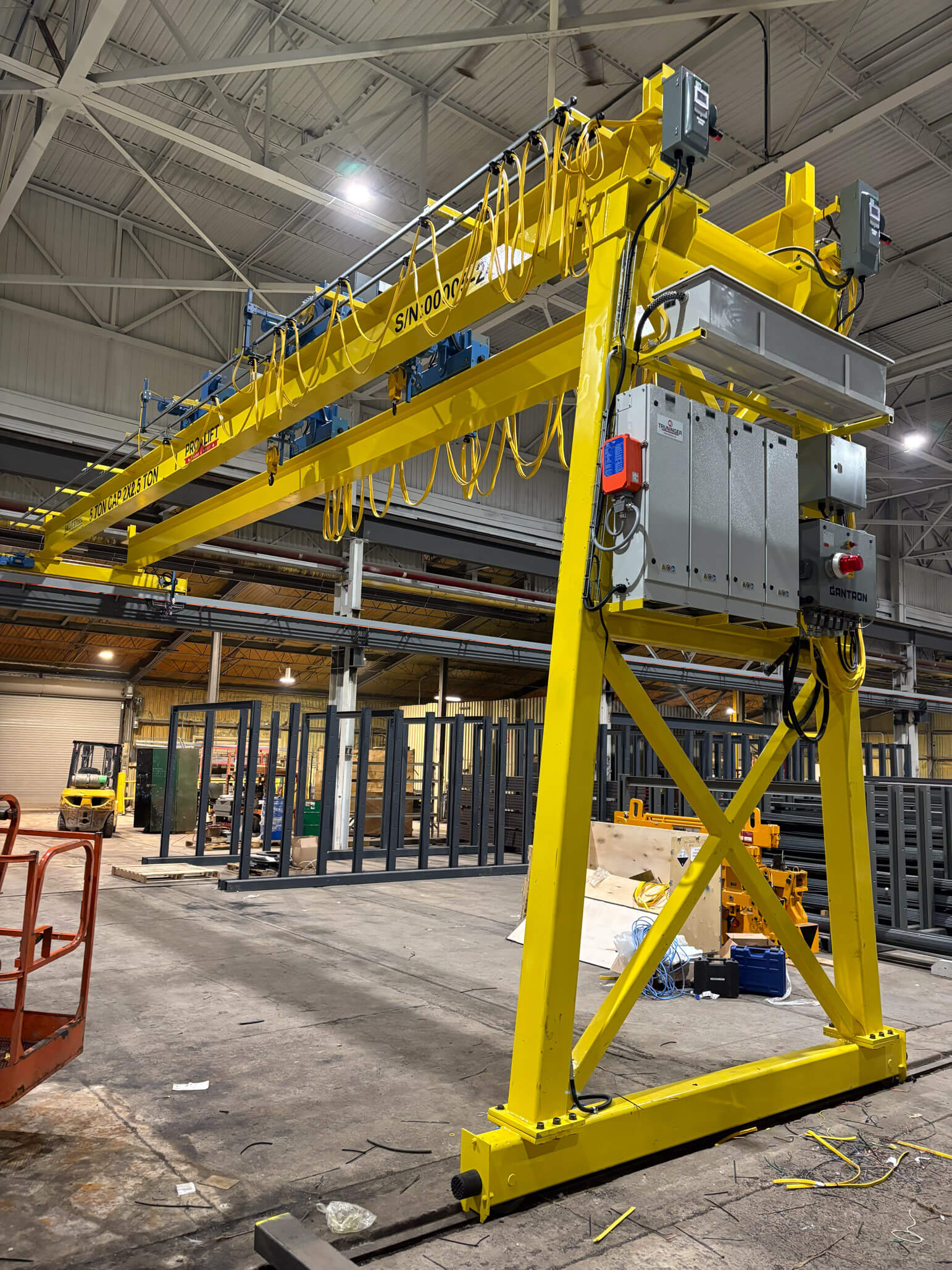
Gantry Cranes: Versatility Without Permanent Structures
Gantry crane frameworks strike the perfect balance between high portability and large-scale, heavy-lifting capabilities.
Unlike bridge setups, gantry cranes are supported by freestanding steel legs rather than elevated runway beams anchored to the building’s columns. The primary bridge spans between these floor legs, while the entire assembly travels on tracks, ground-level rails, or casters. Read more about structural choices on our Industrial Gantry Cranes product page.
Best Applications for Gantry Cranes
- Outdoor storage yards, rail yards, and shipping facilities
- Equipment maintenance bays and temporary construction assembly
- Rented facilities or plants lacking structural overhead column support
Lighter, mobile styles are also popular choices in mechanical service shops and small fabrication lines.
Advantages of Gantry Cranes
- Zero Ceiling Modifications: Because the assembly is freestanding, you bypass the need for structural overhead reinforcements.
- High Portability Profiles: Many gantry crane configurations can be dismantled, reassembled, or rolled to new zones as production flows change.
- Indoor and Outdoor Flexibility: Operates reliably in harsh environments where fixed overhead framing is impossible. With the assumption you have a fairly level floor.
- Lower Initial Infrastructure Investment: Allows facilities to secure heavy-duty material tracking without retrofitting older buildings.
Limitations of Gantry Cranes
Gantry units introduce floor obstructions, as the supporting wheel track paths occupy floor space and can impede passing plant traffic. They can also prove less efficient in high-volume, high-cycle internal manufacturing environments where a dedicated overhead crane system remains faster.
Industrial Crane Comparison: Capacity, Span, and Cost
| Feature | Bridge Crane | Jib Crane | Gantry Crane |
|---|---|---|---|
| Primary Function | Full-facility lifting | Localized workstation lifting | Portable or tracked travel |
| Lifting Coverage | Large rectangular envelope | Circular or semi-circular area | Linear or mobile track path |
| Typical Capacity | 1–100+ tons | 250 lbs–5 tons | 1–20+ tons |
| Span Capability | Up to 132’-0” | 20’-0” (depends on capacity) | Up to 132’-0” |
| Hoist Movement | True X-Y-Z movement | Rotational angular movement | Linear bridge tracking |
| Installation Profile | Permanent overhead system | Column, wall, or floor mast | Floor fully, partial tracks, full tracks. |
| Cost Range | Moderate | Lowest | Highest |
| Floor Space Impact | Minimal (Elevated) | Minimal footprint |
Moderate floor path footprint |
Key Factors: Ceiling Height, Building Support, and Portability
Selecting the correct model involves evaluating more than load weights alone. Your specific building structure often dictates the practicality of your overhead crane solutions.
Ceiling Height & Clearance
Bridge systems require adequate vertical headroom for runway beams, girders, hoist pathways, and clear load passage. Low ceilings can restrict your hoist envelope or require specialized underhung crane engineering. Jib systems require far less overhead line space, while mobile gantry designs can operate under architectural parameters where bridge infrastructure cannot fit.
Building Structural Support
Overhead bridge cranes exert immense dynamic loads onto a facility’s framing. Installing one may require reinforced columns, concrete foundation reviews, and professional engineering metrics. Older buildings often lack this load capacity. Gantry units eliminate these ceiling concerns entirely by routing load forces straight down to the floor slab.
Portability & Future Scalability
If your manufacturing facility layout changes frequently, a modular or mobile gantry structure offers excellent long-term adaptation. However, stable assembly lines with predictable path routines consistently secure the best long-term efficiency by deploying fixed overhead track infrastructure.
Always plan for future scaling. Selecting a crane system based solely on current volume can cause processing bottlenecks within a few years if material weights or volumes increase.
Understanding CMAA Crane Classifications
Another critical parameter in your system evaluation is the operational duty class. The Crane Manufacturers Association of America (CMAA) segments equipment from Class A to Class F based on cycle density, load ratios, and harshness of operating conditions.
- Class A/B: Infrequent, maintenance, or light standby cycles.
- Class C: Moderate everyday production (standard machine shops and fabrication layouts).
- Class D: Heavy industrial processing and continuous raw material movement.
- Class E/F: Severe-duty or continuous, automated manufacturing.
Selecting an underrated duty classification leads to accelerated mechanical wear and expensive unplanned downtime. Always align your layout choice with daily lifting frequencies and average load percentages rather than max weight ratings alone.
When Should You Use a Gantry Crane Instead of a Bridge Crane?
A gantry configuration is the ideal solution when:
- The facility’s architectural structure cannot support elevated runway steel.
- The lifting operation occurs in an outdoor storage yard or temporary zone.
- The factory floor layout reconfigures frequently, requiring portable material handling.
- Upfront budget constraints make overhead facility retrofits cost-prohibitive.
Conversely, an elevated bridge configuration is preferred when maximizing high-speed manufacturing output, keeping every inch of the shop floor clear of wheel track paths, and prioritizing long-term workflow scalability.
Final Thoughts: Matching the Crane to Your Workflow
There is no singular “best” crane setup. The most successful choice aligns perfectly with your facility’s physical structure, lifting envelope requirements, cycle frequencies, and production budgets.
- Bridge cranes deliver unmatched, facility-wide logistics for high-volume operations.
- Jib cranes offer compact, highly economic ergonomic support right at the work cell.
- Gantry cranes combine heavy-duty structural lifting capacity with the flexibility of freestanding infrastructure.
Finding the Right Track for Your Shop
At Pro-Lift Crane & Hoist, we assist Ontario manufacturers in navigating their facility parameters to install reliable, safely engineered material handling platforms. Whether your shop requires a light enclosed-track workstation crane or a high-capacity industrial installation, our team ensures your upgrade delivers safety and efficiency for decades to come.
Ready to Optimize Your Facility’s Material Flow?
Don’t compromise your production floor’s efficiency with a mismatched lifting layout. Let our expert engineering team evaluate your building’s structural limits, material flow velocities, and accurate capacity demands.
Contact Pro-Lift Crane & Hoist Today for a Custom Workspace Evaluation, or reach out to our Ontario office to review your facility blueprints directly with an overhead lifting expert.