When your shop needs overhead lifting coverage, a traditional bridge crane is not always the right answer. You may need to move heavy components around a workstation, load and unload machinery, or position materials precisely without investing in a full-scale overhead crane system.
That is where Met-Track Workstation Cranes come in.
Made in Canada, Met-Track provides a practical solution for light-duty overhead lifting that combines the coverage of an overhead crane with the flexibility and affordability modern workstations need. The system is completely modular, can be extended or relocated as your shop changes, and can be configured for precise manual movement or fully motorized operation.
For Canadian manufacturers looking to improve material handling without taking on the cost and complexity of a traditional bridge crane, a Met-Track workstation crane offers a smarter way to get overhead lifting coverage where you need it.
What Is a Met-Track Workstation Crane?
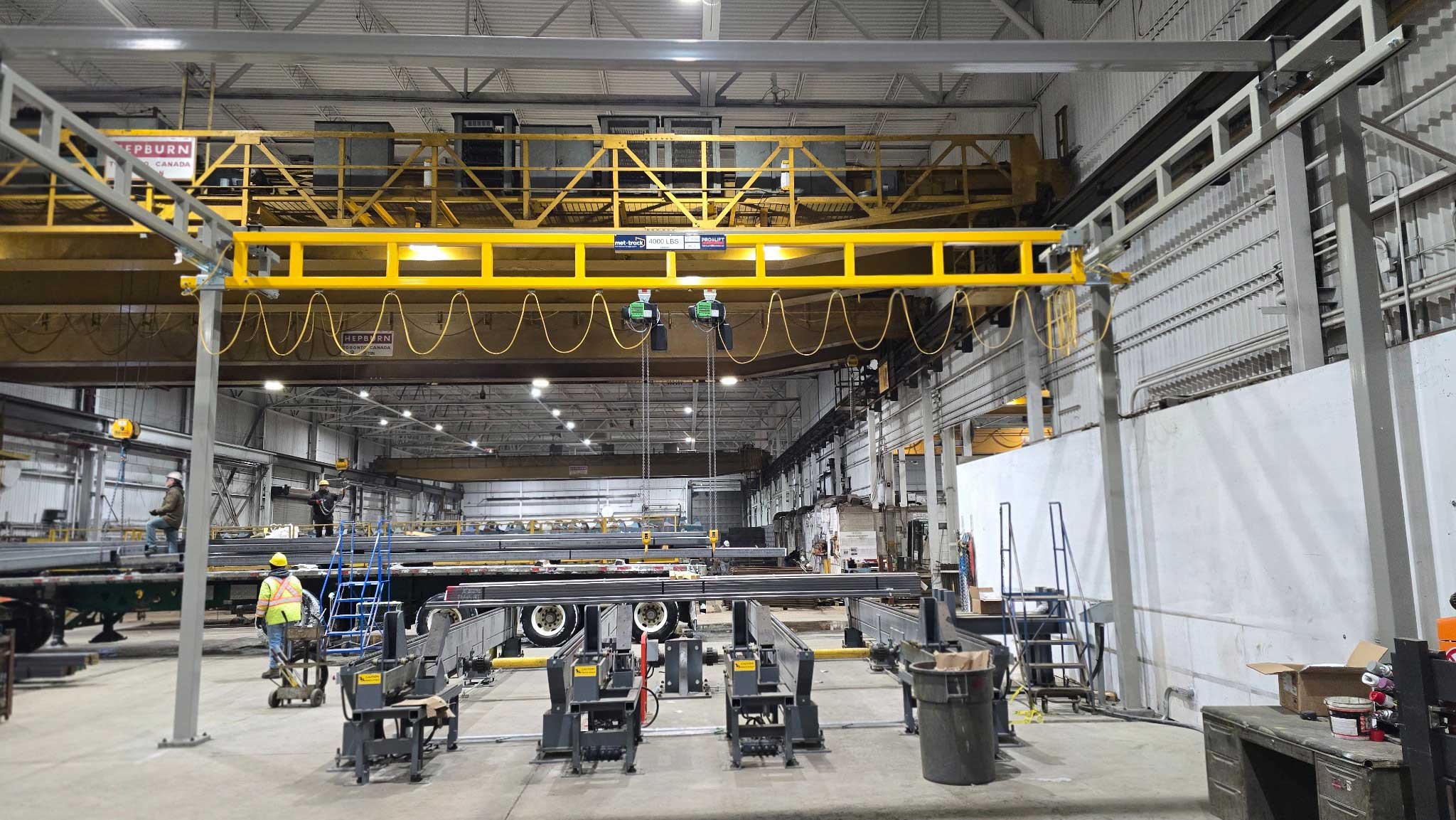
A Met-Track Workstation Crane is a modular overhead lifting system designed for light-duty overhead lifting and material handling within manufacturing, assembly, maintenance, and industrial workspaces.
Instead of relying on a large structural bridge crane, Met-Track uses an enclosed track system to create a dedicated lifting path above the workstation. A trolley and hoist can then move along the track, allowing workers to pick up, position, and move loads with significantly less physical effort.
The result is overhead crane coverage where it matters most, without requiring an entire facility-wide crane system.
A Canadian-Made Solution for Light Lifting
Met-Track is a Canadian-made solution designed specifically for the demands of light lifting applications. For shops that need ergonomic material handling at individual workstations, production cells, or assembly areas, it provides a practical alternative to installing a much larger crane system.
That makes Met-Track particularly useful when your lifting requirements are important, but do not justify the infrastructure or investment associated with a full bridge crane.
Overhead Crane Coverage at Half the Cost
One of the biggest advantages of Met-Track is its ability to reduce overall workstation crane costs, offering the practical benefits of overhead crane coverage at approximately half the cost of a traditional overhead crane system. That difference can make overhead lifting accessible to operations that might otherwise rely on manual lifting, forklifts, carts, or more expensive crane infrastructure.
Rather than paying to cover your entire facility when you only need lifting support in specific areas, Met-Track allows you to build coverage around the way your workers actually move materials.
Why Pay for More Crane Than You Need?
A full bridge crane makes sense when you need to move heavy loads across a large production floor. But many everyday lifting tasks happen within a much smaller area.
Consider a workstation where an employee repeatedly moves components between a pallet, machine, assembly table, and storage area. A facility-wide bridge crane may provide more coverage than that task requires.
Met-Track can be installed directly around the work area, giving workers overhead lifting capability without the expense of building a full bridge crane system.
Precise Manual Movement Where You Need It
Not every lifting application requires powered movement. In many workstation environments, operators need to make small, controlled adjustments to position a load exactly where it belongs. Met-Track allows for precise manual movement, giving operators direct control over the load as they move it along the track.
This can be particularly useful for assembly, machine loading, fabrication, maintenance, and other applications where positioning accuracy matters as much as load capacity and span.
Fully Motorized Options Are Available
For applications with higher cycle rates or longer travel distances, Met-Track can also be configured for powered movement. Motorized systems can reduce the physical effort required to move loads and make repetitive material handling more efficient. This gives facilities the flexibility to choose the level of automation that makes sense for their workflow.
Start with manual movement where appropriate and add powered capabilities where your production demands require them.
Pair Met-Track With a Low-Cost Electric Chain Hoist
Met-Track workstation cranes can be paired with electric chain hoist integration using low-cost electric chain hoists to create an efficient lifting solution without unnecessarily increasing system costs.
An electric chain hoist provides powered vertical lifting, while the Met-Track system provides the overhead travel path. Together, they give operators a straightforward way to raise, move, and position materials around the workstation.
This combination can be an effective choice for shops looking to improve lifting ergonomics and productivity while keeping their material handling investment under control.
Take the Heavy Lifting Away From Your Workers
Manual material handling can put unnecessary physical demands on employees, particularly when the same lifting tasks are repeated throughout a shift.
Even relatively light components can become difficult to handle when workers are constantly lifting, lowering, repositioning, or carrying them.
A Met-Track workstation crane allows the crane and hoist to handle the weight, so workers can focus on controlling and positioning the load instead of physically carrying it, achieving meaningful repetitive strain reduction.
Better Ergonomics at the Workstation
Moving lifting tasks overhead can help reduce the amount of manual force required from workers. Instead of lifting a component from the floor or carrying it across the workstation, an operator can use the hoist to raise the load and guide it along the track. This can make repetitive lifting tasks easier to manage while helping create an environment focused on ergonomic material handling.
For operations where employees regularly handle components, tooling, machinery parts, or other materials, that change can have a meaningful impact on the way work gets done while supporting workplace safety guidelines recommended by organizations like the Canadian Centre for Occupational Health and Safety (CCOHS).
Completely Modular and Built to Change With Your Shop
Manufacturing environments rarely stay exactly the same. Production lines move. Workstations change. Equipment gets replaced. New processes are introduced.
Your crane system should be able to adapt with them.
Met-Track functions as a flexible modular bridge crane system, allowing components to be extended, relocated, and modified as your requirements change.
Extend Your Crane Coverage
Need to cover a larger workstation in the future? Met-Track can be extended to accommodate changing requirements. Instead of replacing an entire crane system when your workspace expands, a modular track system gives you the flexibility to adapt your existing material handling infrastructure.
Relocate the System as Your Layout Changes
If a workstation moves, your crane does not necessarily have to stay behind. Met-Track systems can be relocated when production layouts change, making them particularly useful for facilities that regularly reconfigure their manufacturing or assembly areas.
Modify the System for New Applications
Your lifting requirements can also change over time. A workstation that originally handled one type of component may eventually be used for another process with different material handling requirements. The modular nature of Met-Track makes it possible to modify the system rather than starting from scratch.
Met-Track vs. Traditional Bridge Cranes
A traditional bridge crane remains an excellent choice for large-scale, facility-wide lifting. However, it is not necessarily the most economical solution for every application.
Met-Track occupies a different space in the material handling market, serving as a versatile modular bridge crane that provides overhead lifting coverage for localized workstations and production areas.
| Feature | Met-Track Workstation Crane | Traditional Bridge Crane |
| Primary Application | Light-duty workstation lifting | Facility-wide heavy lifting |
| Coverage | Workstation or production cell | Large rectangular facility area |
| Movement | Manual or motorized track movement | Powered bridge and trolley movement |
| Hoist Options | Compatible with electric chain hoists | Multiple hoist configurations |
| Installation | Modular overhead track (enclosed track system) | Permanent runway and bridge structure |
| Flexibility | Can be extended, relocated, and modified | Generally permanent |
| Infrastructure | Lower infrastructure requirements | Greater structural requirements |
| Cost | Approximately half the cost of traditional overhead crane coverage | Higher initial investment |
| Ideal Use | Individual workstations and production cells | Large-scale material movement |
The right choice ultimately depends on your lifting envelope, load capacity and span requirements, facility structure, and production workflow. For localized light lifting, however, Met-Track can provide the overhead coverage you need without paying for infrastructure you do not.
Where Do Met-Track Workstation Cranes Work Best?
Met-Track can be used across a wide range of industrial and manufacturing applications where workers need to repeatedly lift and position materials.
Common applications include:
- Machine shops and CNC workstations
- Manufacturing and assembly lines
- Welding and fabrication workstations
- Maintenance and repair areas
- Tooling and die handling
- Machine loading and unloading
- Material staging areas
- Parts handling and component assembly
- Packaging and production workstations
The key is identifying areas where employees regularly need to lift, move, or position materials and determining whether overhead coverage could make that process safer and more efficient.
Is Met-Track Right for Your Shop?
If your operation regularly relies on employees to manually lift materials, a workstation crane solution can be a practical way to improve material handling without committing to a major overhead crane installation.
A Met-Track workstation crane may be particularly well suited to your application if you need:
- Light-duty overhead lifting capabilities
- Precise load positioning
- Manual or powered movement
- An affordable alternative to a traditional bridge crane
- Seamless electric chain hoist integration
- A modular system that can grow with your operation
- The ability to relocate or modify your lifting system
- Repetitive strain reduction for daily tasks
The goal is not to install the biggest crane available. It is to provide the right lifting capability exactly where your workers need it.
Build Your Crane Around Your Workflow
Met-Track Workstation Cranes offer manufacturers a practical approach to light-duty overhead lifting. Made in Canada and designed around modularity, they provide the overhead coverage, control, and ergonomic benefits of a workstation crane without the cost and infrastructure associated with a full bridge crane system.
With precise manual movement, fully motorized options, compatibility with electric chain hoists, and the ability to extend, relocate, or modify the system, Met-Track can adapt as your shop changes.
Most importantly, it takes the heavy lifting away from your workers and puts it where it belongs: on the lifting equipment.
Final Thoughts
A Met-Track Workstation Crane does more than move heavy loads. It gives workers precise control over materials, reduces the physical demands of repetitive lifting, and provides overhead coverage without the cost and infrastructure of a traditional bridge crane.
The best workstation crane is one designed around the way your team actually works. Whether you need precise manual movement at a dedicated workstation, a fully motorized system for repetitive lifting, or a modular solution that can be extended and relocated as your shop changes, Met-Track gives you the flexibility to build a system around your operation.
At Pro-Lift Crane & Hoist Inc., we help Canadian manufacturers find practical lifting solutions based on their equipment, layout, workflow, and lifting requirements. Learn more about Met-Track Workstation Crane systems and discover how a modular overhead lifting solution can help take the heavy lifting off your workers while keeping your operation moving.
Ready to Optimize Your Workstation Lifting?
Upgrade your facility with flexible, Canadian-made Met-Track solutions. Contact Pro-Lift Crane & Hoist today to discuss your application and request a tailored quote for your shop.